
Introduction
The first decision that you must make after starting a blog is to choose your niche; it could ultimately determine your success or failure as a blogger. Many new bloggers jump into this part of their blogging journey too quickly without really taking time to explore their options; this often leads to frustration and abandonment because they were never able to determine what their blog should be about.
If you do not choose a niche that is appropriate for you and is well-defined, then it will be very difficult for both search engines and your potential readers to understand what kind of content you will be publishing.
So now let’s take a look at what a blog niche is and how it can affect your long-term success. A blog niche refers to the topic of your blog or what the main focus of your blog will be over the course of its existence. For example, instead of writing about a variety of different things, you would select one topic and work towards a common audience that shares your interests.
In this article, we discuss the definition of a blog niche and also provide you with information on choosing a successful niche that has potential for growing your blog and earning income from your blog. If you can get this step right, you will be much more successful at achieving your overall blogging goals.
What is a blog niche?

A blog niche is a defining topic you will cover in your blog, along with the audience you will cater for. A blog niche will also provide you with the foundation of your blogging strategy and will dictate your writing, as well as your audience, and will also influence your blog’s growth over time.
When you do not have a blog niche, you may have inconsistent posts and be unable to generate an interested and continual audience, or to create sufficient content to rank on search engines.
For instance, if I posted a blog article about travel today, equipment for digital photography tomorrow, and then the next day wrote about cooking, my blog would be unfocused; visitors to my blog would not know what they could expect and would be less likely to return.
But when you post an article on a blog with a specific blog niche – for example, a blog dedicated exclusively to creating online income for beginners – you will have a dedicated audience, and the blog will provide clear purpose, making it much easier to create an entire audience with whom to engage.
Furthermore, your blog will have focused content in one niche; therefore, you will be able to establish authority for your blog in that niche, rather than having such a fragmented approach to blogging that your efforts cannot be monetized by search engines or cannot help you rank high on search engines like Google.
The Importance of a Blog Niche
Choosing a niche will allow you to target a more specific audience.
By having a specific niche defined, you are not trying to provide information for the whole world, you are writing specifically for a target group. As a result, the information provided in your content will be more relevant and engaging to the reader, as well as be perceived as being of greater value, which will encourage them to return to your site.
When you create a targeted audience, they are much more likely to trust your recommendations, share your content and interact with your site. This provides a solid base for long-term business growth and success.
Improves SEO (Search Engine Optimization)
Search engines look at the consistency of content published at a particular website as well as the level of expertise demonstrated in the content. The more your blog focuses on a particular niche, the easier search engines will know what the blog is about. As a result, you will have greater potential for ranking well on search engine results for terms that have correlation to the content you posted on your blog.
For example, if a blog consistently publishes articles about generating income online, the search engines (particularly Google) will begin associating that site with that particular subject. Eventually your information will show up in the search engine results pages more often, resulting in the blog getting organic traffic with little or no advertising costs.
Establishes Authority and Builds Trust
The establishment of trust depends on how much you actually write about a particular subject, as well as your level of experience, knowledge, and expertise with that subject. When people see that you regularly write about a particular subject and that you provide credible, quality content for that subject, they will eventually begin to believe that you are an authoritative source on that subject; thus, they will trust you, and they will follow you, read your blog, and purchase products you recommend.
Establishing authority can help distinguish you from your competitors. You become more than just another typical blog that covers multiple subjects; rather, you become more of an expert in a particular subject or specialty, and that will yield benefits in the long run.
Makes Monetization Easier
When you have a well-defined niche, it will be much easier for you to monetize your blog. If you want to use Google AdSense, do affiliate marketing, or sell your own product(s), you will have an increased likelihood of succeeding at it due to the fact that you will have a targeted audience.
As a result of focusing your blog content on your niche subject, the ads that will appear on your site will be much more relevant to your current audience, which will lead to an increased number of clicks on the ads. Furthermore, when you recommend affiliate products, your audience’s interest in the same area (or niche) as the affiliate products will increase your chances of converting them into sales.

As shown in the image above, focusing on a clear blog niche can lead to steady traffic growth over time through SEO, content strategy, and consistency.
There are Different Types of Blogs to Start
There are three different categories of blog niches:
- Broad niche
These are broad categories like health, tech and business. They are huge topic areas and attract huge audiences but are also very competitively fought over by established sites which have a lot of authority.
So as a new person to blogging it is going to be difficult for you connecting to an established site in a broad niche.
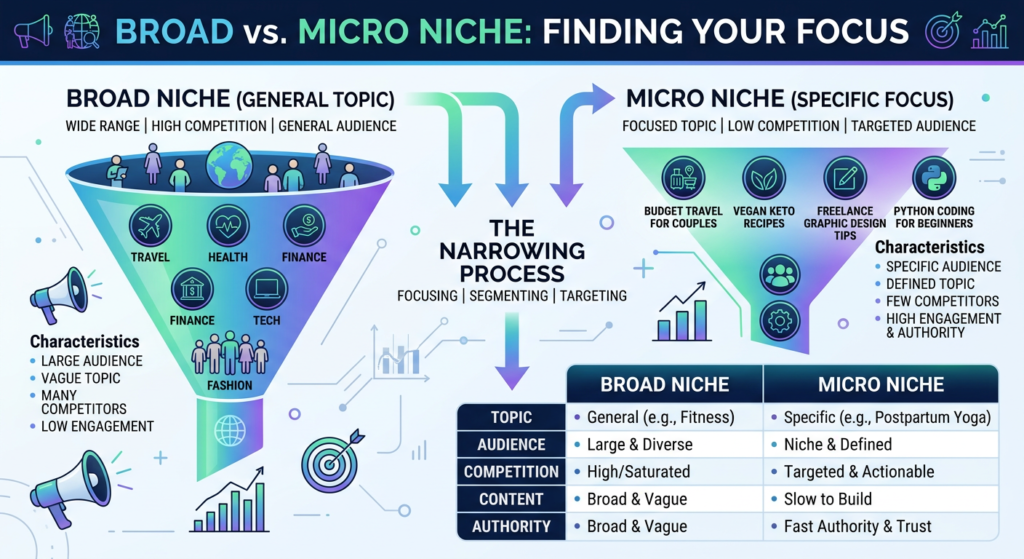
The image above clearly shows the difference between a broad niche and a micro niche, highlighting why narrowing your focus leads to better SEO and audience targeting.
- Micro niche (the best way to go)
Micro niches are very small parts of a larger category. Instead of trying to target a large audience, you eliminate your target audience down to smaller segments with that have specific needs or interests.
When you narrow your blog to a specific niche, it becomes much easier for search engines to understand your content and rank it higher, helping you attract the right audience faster.
For instance, instead of blogging about “technology,” you could blog about ”AI tools for college students.” By narrowing the focus of your blog your competition is decreased while still allowing you to target a growing and money making audience.
- Evergreen niche
Evergreen niches are topics that do not get old and receive search traffic consistently. They are great for a long term blog because they allow a constant supply of visitors no matter what is in vogue at any given time.
Some examples of evergreen niches would be Personal Finance; Health and Fitness; and Making Money Online. Each of these categories will always be popular, so they are solid choices for creating a sustainable blog.
Trending Niches – High Interest, Short-Term Growth
Numerous niches are trending around current topics that receive a lot of attention within a relatively short time. They provide quick traffic to a website and can be used as a driver of traffic, but they may not necessarily create the demand for a long-term successful business model. By using other evergreen niches along with trending niche topics will give the opportunity to create growth both long- and short-term.
How to Choose the Right Blog Niche
Pick Something You Love
The passion you feel about what you will write about in your niche will be critical to your overall ability to maintain consistency in blogging. You will need to create new content on a regular basis for your blog. If the niche you choose is not something you have a desire to write about, you will have a difficult time being motivated and staying engaged with your blog. Eventually you will burn out and might abandon the blog altogether.
Research Popularity of The Niche
A good niche is comprised of people who are actively searching for information about the topic. Utilizing tools such as Google Trends and keyword research tools can help you find out what kinds of keyword searches people are currently using. This ensures that you have a reason to create content and that your content will meet the needs of the people looking for it.
Review Your Niche Competitiveness
While quantity of competition indicates that there is a viable and profitable niche, too much competition can hinder your ability to grow your business as a newbie. The objective is to choose a niche with plenty of overall demand but that is not overly saturated.
Check Monetization Potential
Before you begin establishing your niche, ask yourself how you will create revenue from it. A successful and well-defined niche will provide you multiple streams of income; whether you decide to earn through advertising, affiliate marketing, or selling digital products.
Refine Your Niche
One of the best tips for blogging is to narrow your niche. Instead of pursuing a more generalized theme, you should determine what areas of interest and provide a more narrow niche. This will not only attract a more engaged audience, but also increase your chances of success.
Before choosing your niche, it’s important to understand the basics of blogging. You can read our complete guide on how to start a successful blog to learn step-by-step how to set up and grow your website.
Common Mistakes to Avoid
Using too Many Topics
If you are trying to cover many unrelated topics, you will dilute your overall brand and confuse your readers; making it more difficult for search engines to classify your content—resulting in declines of traffic (SEO).
Not Utilizing Search Engine Optimization (SEO)
Even if you find the right niche, you will not be successful unless you properly implement SEO. You should utilize your target keyword(s), optimize your content for structure and usability and generate content that adds value and is informative for your readers.
Quitting Too Soon
Blogging is not something that you will have early success with; it takes a long time to generate visitors and establish authority. Many beginning bloggers give up after creating only a few posts, but many of those who do so consistently and build their networks become successful.
Copying Someone Else’s Work
You need to look at what other successful blogs are posting when you’re trying to become a better blogger, but if you are simply copying them, you are never going to stand out as a different type of blogger. You have to create your own unique spin on the material you want to write about.
Final Thoughts
The most significant step to starting a blog is identifying what your niche is going to be. It is the foundation for creating your content, defining who your audience will be, and strategically growing your revenues. If you don’t know what your blogging niche is – you will be working in a haphazard fashion, without any structure or direction.
In order to see any substantial growth, it’s necessary to pick one niche to concentrate on, continue working within that niche and be diligent about creating quality content that is of value to your audience. Once you’ve done that, you will see your reputation as a blogger grow and will be able to monetize your effort over time.

This breakdown of blog niches really resonated with me—especially the part about choosing a niche that aligns with your interests and audience. It’s easy to jump into blogging without a clear focus, but as the post highlights, having a defined niche makes it much easier to build a loyal readership and grow sustainably. Thanks for the practical advice on avoiding common mistakes early on.